Quick answer: Wyckoff analysis is a way of reading supply and demand from price and volume together. It assumes large, informed money (the "composite operator") accumulates positions inside sideways trading ranges after declines and distributes them in ranges after rallies, and it maps those ranges as phases A to E with named events like the selling climax and the spring. Indicator-based technical analysis applies formulas to price; Wyckoff interprets the whole range, which makes it richer and more subjective.
Every candle on a chart is a receipt: somebody bought, somebody sold, and price moved. The interesting question is never what happened. It's who was doing the heavy lifting, and whether they're building a position or quietly heading for the exit. Wyckoff analysis is a century-old framework for answering exactly that question, and it maps naturally onto crypto's transparent, around-the-clock markets.
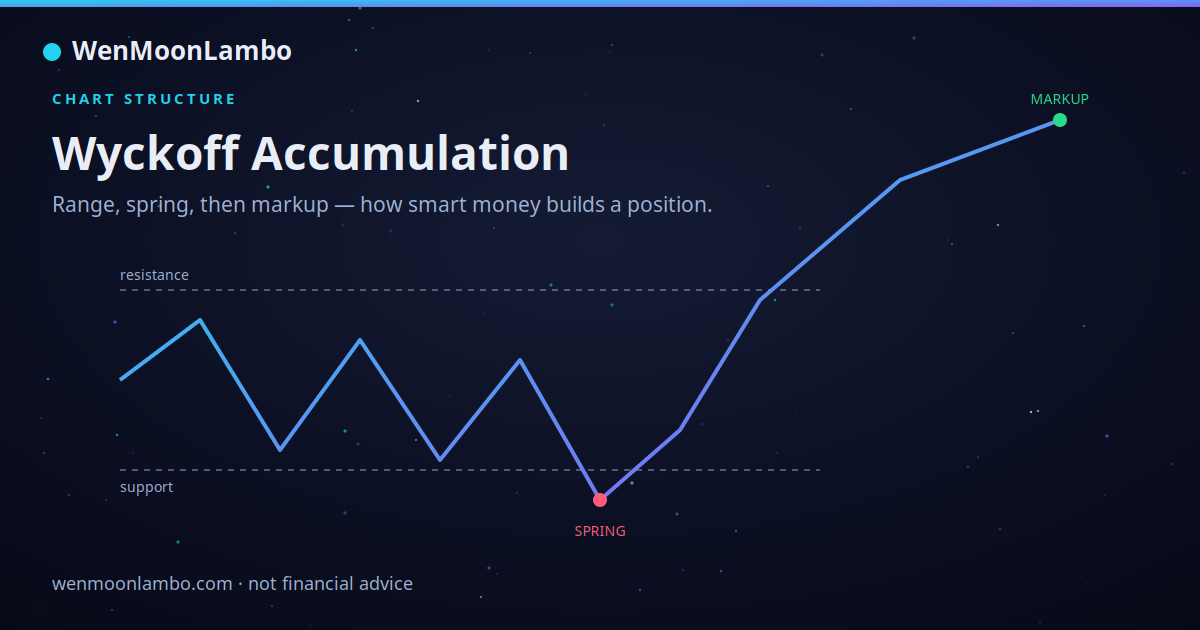
This guide covers the method itself, how it differs from indicator-based technical analysis, and a worked example on Bitcoin's 2022–2023 bottom using real Binance data, including the parts that didn't fit the textbook.
Who was Richard Wyckoff?
Richard Demille Wyckoff (1873–1934) was an American trader, publisher and educator. He started on Wall Street as a stock runner at 15, ran his own brokerage firm while still in his twenties, and in 1907 founded The Ticker, renamed The Magazine of Wall Street in 1911. He spent decades studying how the large operators of his era, such as Jesse Livermore and J.P. Morgan, actually built and unloaded positions. Then he did something unusual for his time: he wrote it all down for the ordinary investor. In the 1930s he started a school that later became the Stock Market Institute, and near the end of his life he sold his method as a correspondence course.
One historical footnote matters for anyone reading Wyckoff today. Much of what is now called "the Wyckoff method" was reworked and extended after his death by later teachers and by the school he founded. Robert Evans, who taught the method from the 1930s to the 1960s, gave us the "creek" metaphor you'll meet below. So when people say "Wyckoff said," they often mean "the Wyckoff tradition says."
His core observation was blunt. Markets aren't moved by headlines or luck; they're moved by big money running campaigns: accumulating quietly, marking price up, distributing into excitement, then stepping aside for the decline. The public, he argued, tends to do the opposite at every step, selling the boring bottom and buying the euphoric top. His method is a field guide to spotting those campaigns while they're happening, using nothing but price and volume.
You don't have to treat any of this as gospel. Treat it as a lens. It's less a signal system than a way of asking better questions about every chart you open.
The three Wyckoff laws
The whole method rests on three ideas.
| Law | What it says | What you look for on a chart |
|---|---|---|
| Supply and demand | Price rises when demand exceeds supply and falls when supply exceeds demand | Who is winning the range: are rallies or drops getting the follow-through? |
| Cause and effect | A trading range is the "cause" being built; the trend that leaves it is the "effect," roughly proportional to the cause | Longer, wider ranges set up bigger moves. Traditionally the cause is measured with a horizontal point-and-figure count |
| Effort vs result | Volume is the effort, price movement is the result; they should agree | Heavy volume with little price progress (or a big move on thin volume) warns that the trend may be changing |
The composite operator: the big idea behind Wyckoff analysis
Wyckoff's most useful teaching device is the "composite operator" (often called the "composite man"): imagine all the big, informed money in a market as a single person sitting behind the tape, running one coherent campaign.
This person wants to buy size without pushing price up on themselves, and to sell size without cracking the market before they're done. So they behave in recognisable ways:
- They buy into fear, when everyone else is dumping and there's plenty of supply to absorb.
- They sell into euphoria, when demand is frantic enough to soak up everything they unload.
- They engineer tests (shakeouts and fake breakouts) to find out how much supply or demand is genuinely left.
Is there literally one puppet-master behind Bitcoin? Of course not. But the fiction is useful. When you look at a trading range and ask "what would the composite operator be doing here?", you stop reacting to individual candles and start reading the campaign. That single habit is most of what Wyckoff analysis has to offer.
The four-stage cycle: accumulation, markup, distribution, markdown
Wyckoff described markets as moving through a repeating cycle of four stages.
Accumulation. After a decline, price stops falling and drifts sideways, often for a painfully long time. The character of the tape changes: heavy selling gets absorbed without fresh lows, and downside probes recover quickly. This is where patient money builds positions from exhausted sellers. It looks boring. It is anything but.
Markup. Demand finally overwhelms the remaining supply and price breaks out of the range. Pullbacks stay shallow and get bought. This is the trending phase everyone wishes they'd caught earlier, and the phase where chasing feels safest, right as late entries start becoming someone else's exit liquidity.
Distribution. The mirror image of accumulation. Price churns sideways near the highs while large positions are handed off to enthusiastic latecomers. Rallies stall despite strong volume, breakouts fail, and the range gets choppy and headline-rich. From the outside it looks like consolidation before the next leg up. Sometimes it is. Often it isn't.
Markdown. Supply wins, support gives way, and price trends down until sellers are spent. Then the whole cycle can begin again.
Two honest caveats. The stages never announce themselves in real time; you're always working with evidence, not certainty. And they nest: a weekly accumulation can contain daily distributions inside it. A range can also resolve the "wrong" way. Wyckoff practitioners call a range inside an uptrend that breaks higher re-accumulation, and one inside a downtrend that breaks lower redistribution. The cycle isn't a prediction machine. It's context.
Accumulation and distribution schematics: phases A to E
Later Wyckoff teachers split each trading range into five phases. The accumulation and distribution versions mirror each other.
| Phase | In accumulation | In distribution |
|---|---|---|
| A: stopping the trend | The downtrend stops: preliminary support, a selling climax, an automatic rally and a secondary test | The uptrend stops: preliminary supply, a buying climax, an automatic reaction and a secondary test |
| B: building the cause | Usually the longest phase. Price swings between the range edges while large buyers absorb supply | Large sellers unload into rallies; tests of the highs and early signs of weakness |
| C: the test | A decisive test of remaining supply, often a spring below the range low | A test of remaining demand, often an upthrust after distribution above the range high |
| D: trend inside the range | Demand takes over: signs of strength and higher lows toward the top of the range | Supply takes over: signs of weakness and weak rallies toward the bottom of the range |
| E: trend outside the range | Price leaves the range and markup begins | Price breaks down and markdown begins |
Not every range shows every phase cleanly. Springs and upthrusts after distribution are common but not required, and phase B can drag on far longer than anyone expects.
Wyckoff events cheat sheet
| Event | Name | One-line meaning |
|---|---|---|
| Accumulation | ||
| PS | Preliminary support | The first notable buying after a long decline; the drop starts to slow |
| SC | Selling climax | Panic selling on very high volume and wide ranges, absorbed by large buyers near the low |
| AR | Automatic rally | The bounce after selling exhausts itself; its high marks the top of the range |
| ST | Secondary test | Price revisits the selling-climax area on lighter volume to check whether supply is gone |
| Spring (shakeout) | Spring | A dip below the range low that quickly reverses back inside, trapping late sellers |
| Test | Test | A return to a low on noticeably lower volume, showing little supply left |
| SOS (JAC) | Sign of strength / jump across the creek | A strong advance on rising volume through the top of the range ("the creek") |
| LPS | Last point of support | A pullback after the sign of strength that holds higher, on lighter volume |
| BU (BUEC) | Back-up (to the edge of the creek) | A pullback to the old resistance, which now acts as support, before markup |
| Distribution | ||
| PSY | Preliminary supply | The first heavy selling after a long rally; the advance starts to slow |
| BC | Buying climax | Frenzied buying on very high volume, absorbed by large sellers near the high |
| AR | Automatic reaction | The drop after buying exhausts itself; its low marks the bottom of the range |
| ST | Secondary test | Price revisits the buying-climax area on lighter volume, sometimes as an upthrust |
| UT | Upthrust | A push above the range high that closes back inside |
| UTAD | Upthrust after distribution | A late-range break above the highs that fails; the mirror image of a spring |
| SOW | Sign of weakness | A drop to or below the range low on rising volume and wider spreads |
| LPSY | Last point of supply | A feeble rally on light volume after the sign of weakness; demand is exhausted |
Springs, upthrusts and tests
You can go infinitely deep into the jargon; three ideas cover most of the practical value.
A spring is a dip below a range's support that quickly reverses back inside it. If the breakdown attracted little follow-through selling, it just demonstrated that supply is thin, while conveniently shaking out the last nervous holders. Springs late in accumulation are the classic bear trap.
An upthrust is the same move flipped upside down: a push above resistance that fails and falls back into the range. It suggests demand couldn't sustain the breakout, often because somebody was selling into it. Upthrusts late in distribution are the classic bull trap.
A test is a return to the scene of an earlier battle on noticeably lighter volume. If price revisits the spring low and no meaningful selling shows up, the market has quietly told you how much supply remains.
Notice the common thread: every one of these reads price together with volume. Price tells you what happened; volume hints at how much conviction was behind it. Effort versus result, in Wyckoff's own framing. Big effort with no result is one of the most eloquent things a chart can say.
Wyckoff vs traditional technical analysis
Wyckoff is itself a branch of technical analysis: both study past price and volume rather than fundamentals. The difference is in how. Most modern retail TA is built from indicators and patterns that apply a formula or a rule to price. Wyckoff reads a whole trading range as one story.
| Wyckoff method | Indicator-based technical analysis | |
|---|---|---|
| Core question | Who is accumulating or distributing, and where are we in that campaign? | What is the trend or momentum doing right now? |
| Main tools | Trading ranges, volume, named events (SC, spring, SOS…), phases A–E, point-and-figure counts | Moving averages, RSI, MACD, Bollinger Bands, chart patterns, Fibonacci levels |
| Unit of analysis | The whole range and its sequence of events | Individual signals: a crossover, a divergence, a pattern break |
| Role of volume | Central. Every event is judged on effort (volume) versus result (price) | Often optional or a secondary confirmation (for example OBV or a volume spike) |
| Timeframe and targets | "Cause" built over weeks to months sets the expected size of the next move | Any timeframe; targets from measured moves, prior levels or Fibonacci extensions |
| Subjectivity | High. Two analysts can label the same range differently, and labels get easier in hindsight | Formulas are reproducible, though parameter choice and interpretation still vary |
| Testability | Hard to backtest because the labels are discretionary | Easy to code and backtest, which also makes overfitting easy |
| Good at | Context: whether a range looks like absorption or exhaustion, spotting failed breakouts and traps | Consistent rules, fast scanning across many coins, trend following |
| Weak at | Precise real-time timing; ranges that never resolve; markets where volume is unreliable | Lag; whipsaws inside ranges; says little about why price is moving |
The two combine naturally. Many traders use Wyckoff to decide what kind of market they're in (accumulation range, distribution range, trend) and indicators to time entries or confirm momentum inside that frame. For example, a range that looks like accumulation plus a momentum indicator turning up on the breakout is a more complete argument than either alone. Nobody has shown with rigorous evidence that one approach beats the other; they answer different questions.
Worked example: Bitcoin's 2022–2023 bottom, read in hindsight
Theory is easy to agree with. Here is one real range, with every number computed from Binance's BTC/USDT daily candles. The labels below are one plausible Wyckoff reading made after the fact. Other analysts label this period differently, and in real time it looked far less tidy.
The backdrop. Bitcoin peaked at $69,000 on November 10, 2021. By November 2022 it had spent months grinding lower, through the Terra and Celsius collapses, into the FTX crisis.
| Date | Price action (BTC/USDT, daily) | Volume | Plausible Wyckoff label |
|---|---|---|---|
| Nov 8–9, 2022 | Fell 22.7% in two days (close $20,591 → $15,923), low $15,588 as FTX collapsed | Nov 8 and Nov 9 were the two highest-volume days of Binance's 257-day zero-fee period (see below); Nov 9 was 2.6× its 30-day average | SC, selling climax |
| Nov 10, 2022 | Bounced 10.5% in one day, high $18,199 | Still 2.0× average | AR, automatic rally |
| Nov 21, 2022 | New low at $15,476, just 0.7% under the climax low, closed back at $15,781 | 44% of Nov 9's volume | ST, secondary test on lighter volume |
| Nov 22, 2022 – Jan 11, 2023 | Range between $15,617 and $18,388 (Dec 14 high); the last four weeks only 10.7% wide | Average daily volume 27% of the Nov 8–10 average; quietest day Jan 1, 2023 | Phase B, building the cause |
| Jan 12–14, 2023 | First close above the range high on Jan 12 ($18,847); +16.8% in three days to $20,955 | 2.0–2.6× the 30-day average each day | SOS, sign of strength |
| Mar 10, 2023 | Pullback to $19,549 during the Silicon Valley Bank failure, 6.3% above the old range high | 2.0× average (heavier than the textbook wants) | LPS, last point of support, with a caveat |
| Mar 2023 – Mar 2024 | Mar 17, 2023: first close above the Aug 2022 high of $25,211. Pullbacks to $24,800 (Jun 15) and $24,901 (Sep 11) held near that level. Oct 23, 2023: first close above the July high of $31,804. High of $73,777 on Mar 14, 2024 | JAC/BU at a larger scale, then Phase E markup |
What this reading gets right: a capitulation on extreme volume, a quick rebound that set the top of the range, a retest on less than half the volume, a long quiet range where volume dried up, and a breakout on expanding volume. From the November climax low, Bitcoin went on to rise 373% by March 2024.
What doesn't fit, and why it matters:
- There is no clean spring. The Nov 21 low barely undercut the climax low and is better described as a secondary test. Springs aren't required in Wyckoff's framework, but a beginner hunting for one would have waited in vain.
- The "LPS" came on heavy volume. A textbook last point of support is a quiet pullback. March 10, 2023 was a banking-stress selloff on about twice normal volume. It held above the old range, which is the part that mattered, but it didn't look like the schematic.
- An earlier reading would have failed. Anyone who labelled the June 18, 2022 low ($17,622) as the selling climax of an accumulation range saw price break 12.2% lower in November. It took until December 13, 2022, 34 days after the FTX low, for Bitcoin to close back above $17,622. In real time, that looked like a breakdown, not a spring.
- Exchange volume changed regime in the middle of this range. See the next section: Binance ran zero-fee BTC trading from July 8, 2022 to March 22, 2023, which reshaped the very volume numbers Wyckoff analysis depends on.
The honest summary: the 2022–2023 bottom can be mapped onto an accumulation schematic, and the mapping is instructive. But it's much easier to draw in hindsight, and the clean version hides two false starts.
Why Wyckoff analysis suits crypto
Wyckoff worked from ticker tape in the early 1900s. Crypto hands you raw material he could only have dreamed about.
First, the market never closes. No opening auctions, no weekend gaps, no overnight sessions where the story jumps discontinuously. Volume is one continuous 24/7 record, which is what a volume-based reading method wants.
Second, the data is public and granular. Anyone can pull exchange candles and volume for any major pair, on any timeframe, for free. You don't need an expensive terminal to do serious tape reading.
Third, and less flattering, crypto is full of the behaviour Wyckoff described. Thin altcoin order books, aggressive players, engineered stop-runs, breakouts that seem to exist purely to be sold into. None of that guarantees the method "works"; it does mean the questions it asks are the right questions for this market.
Where crypto breaks the Wyckoff assumptions
The same features that make crypto a good classroom also distort the inputs.
- Volume is fragmented. Bitcoin trades on dozens of spot venues plus perpetual futures. A volume spike on one exchange may be one venue's story, not the market's.
- Promotions and wash trading distort volume. During Binance's zero-fee BTC promotion, average daily BTC/USDT volume jumped from 97,789 BTC in the 30 days before July 8, 2022 to 176,604 BTC in the 30 days after, while the number of trades tripled (1.51 million to 4.72 million a day). After the promotion ended on March 22, 2023, average daily volume over the next 30 days was 82% lower than in the promotion's last 30 days, and the trade count 87% lower. In raw numbers, Nov 9, 2022 shows 3.7× the volume of the June 18, 2022 low. Part of that is real panic, and part is a fee schedule. Compare volume only within the same regime, as the worked example does with its 30-day averages.
- Derivatives drive many moves. Perpetual futures funding and open interest can push spot price around. A "climax" can be a cascade of forced liquidations rather than a deliberate campaign, which looks similar on a spot chart but means something different.
- Liquidation cascades exaggerate springs and upthrusts. Leverage clusters stops just beyond obvious range edges, so wicks through support and resistance are routine. Not every wick is a spring.
- 24/7 trading makes "daily" arbitrary. A daily candle is just a UTC cut-off. Weekend liquidity is thinner, and the same move can look like a spring on one timeframe and noise on another.
- The composite operator may not exist. In stocks, the idea of coordinated large operators was Wyckoff's working model. In crypto, "whales" are real, but much of the flow is many independent funds, market makers and liquidation engines. The fiction is still useful; just don't take it literally.
Does Wyckoff analysis actually work?
Short answer: nobody has shown it rigorously, either way.
We could not find a peer-reviewed study that tests Wyckoff schematics as a rule set, in stocks or in crypto. Most of the evidence offered for the method is case studies, like our Bitcoin example, picked after the fact. That's useful for teaching but it isn't a test: the ranges that failed rarely make it into the tutorials. Testing is genuinely hard, because the labels are discretionary. Two skilled analysts can disagree on where phase B ends.
The wider academic record on technical analysis is mixed. Cheol-Ho Park and Scott Irwin's 2007 survey of 95 modern studies counted 56 with positive results for technical trading rules, 20 negative and 19 mixed, but warned that most suffer from problems such as data snooping, rules chosen after the fact, and hard-to-estimate risk and transaction costs. Andrew Lo, Harry Mamaysky and Jiang Wang (2000) found that some chart patterns carried incremental information in US stocks from 1962 to 1996. Neither study tests Wyckoff specifically, and neither covers crypto.
So the fair position is: Wyckoff is a coherent framework for describing supply and demand, it is widely used by discretionary traders, and its predictive value is unproven. Use it for context and for disciplined questions, size your trades as if any single reading could be wrong, and keep a record of your own calls to see how they actually perform.
How WenMoonLambo surfaces Wyckoff
You can do all of this by hand, and learning to is worth the effort. As a starting point, the Wyckoff panel in WenMoonLambo's technical-analysis terminal runs an automated read on real Binance candles on the 4-hour, daily or weekly chart. It:
- marks the events it detects (selling and buying climaxes, automatic rallies and reactions, secondary tests, springs, upthrusts, signs of strength and weakness, last points of support and supply) and shades phases A to E on the chart;
- gives a phase (accumulation, markup, distribution, markdown, or re-accumulation and redistribution) with a confidence score and a plain-English "Why this read?";
- shows "No clear phase" instead of forcing a label when the evidence is weak, and tells you whether that kind of reading has had a measurable edge in the platform's own backtest, or whether there's too little history to judge.
That read also feeds Signal Nexus, the platform's confluence engine, as one pillar alongside technical indicators, sentiment, derivatives positioning and market cycles (Wyckoff carries 20 of 100 points in the default weighting). So you can see at a glance whether the phase picture agrees or argues with everything else.
If you'd rather build the skill than consume the output, start with the lesson Wyckoff 101: The Market Has a Script in the Stop Staring & Start Learning TA course. It walks through the four acts, the spring, and a hands-on chart lab where you box a suspected accumulation range yourself.
Then put a range idea to work. The $10,000 paper-trading demo is free with no signup, on real Binance market data. When you want the full Wyckoff panel, the course and the rest of the toolkit, an account starts with a 30-day Pro trial, no card needed. A wrong call there costs you nothing but a lesson.
Frequently asked questions
What is Wyckoff analysis in crypto? It's the Wyckoff method applied to crypto charts: reading price and volume together to judge whether a sideways range is accumulation (large buyers absorbing supply) or distribution (large sellers unloading), then mapping it as phases A to E. Bitcoin's November 2022 to January 2023 range is often used as an example; we walk through it above.
Does the Wyckoff method work for crypto? It can describe crypto ranges well in hindsight, but there's no rigorous published test of its predictive power in crypto (or stocks). Crypto also adds complications Wyckoff never faced: fragmented exchange volume, fee promotions that distort volume, and derivatives-driven liquidation cascades. Treat it as context, not a signal.
What is a Wyckoff spring? A spring is a dip below the low of a trading range that quickly reverses back inside, ideally without heavy follow-through selling. It suggests supply is exhausted and often traps late sellers. Springs usually appear in phase C of accumulation, but they're not required.
What's the difference between Wyckoff and Elliott Wave? Elliott Wave, developed by Ralph Nelson Elliott in the 1930s, counts price in repeating wave patterns (five waves with the trend, three against) and treats volume as secondary. Wyckoff doesn't use Elliott-style wave counts; it focuses on trading ranges, volume and the behaviour of large participants. Both are interpretive, and analysts often disagree on counts or labels.
How long does Wyckoff accumulation take? There's no fixed length. Phase B is usually the longest part. In the Bitcoin example, 66 days separated the November 9, 2022 climax from the January 14, 2023 breakout, while the broader bottoming process from the June 2022 low to the March 2023 breakout above $25,211 took about nine months. Higher timeframes produce longer ranges.
What is the difference between Wyckoff accumulation and re-accumulation? Accumulation forms after a downtrend and starts a new uptrend. Re-accumulation is a similar-looking range that forms during an uptrend, a pause before the trend continues. The schematics look alike; the prior trend is what tells them apart.
What are the three Wyckoff laws? The three Wyckoff laws are supply and demand, cause and effect, and effort versus result. Price rises when demand exceeds supply; a trading range is the cause that sets up a roughly proportional trend; and volume (effort) should agree with price movement (result), or the trend may be changing.
What is the Wyckoff composite man? The composite man, or composite operator, is a teaching device: imagine all the big, informed money in a market as one person running a single campaign. They buy into fear, sell into euphoria and engineer shakeouts to test remaining supply or demand. It is a useful fiction, not a literal puppet-master.
What are the five phases of Wyckoff accumulation? Wyckoff accumulation is split into phases A to E. Phase A stops the downtrend, phase B builds the cause and is usually the longest, phase C tests remaining supply (often with a spring), phase D shows demand taking over, and in phase E price leaves the range as markup begins.
How is Wyckoff different from technical analysis? Wyckoff is itself a branch of technical analysis, but it reads a whole trading range as one story built on volume and named events, while indicator-based analysis applies formulas such as RSI or moving averages to price. Wyckoff gives richer context but is more subjective and much harder to backtest.
What is a UTAD in Wyckoff distribution? A UTAD, or upthrust after distribution, is a late-range break above the highs that fails and falls back inside the range. It is the mirror image of a spring and suggests demand could not sustain the breakout. Upthrusts late in distribution are the classic bull trap.
The bottom line
Wyckoff analysis isn't a crystal ball, and anyone selling it as one is doing it wrong. It's a discipline: read price and volume together, imagine the campaign behind the candles, and locate yourself in the accumulation–markup–distribution–markdown cycle before you form an opinion. Springs, upthrusts and tests are the market answering the only question that matters: how much supply and demand is really left?
Bitcoin's 2022–2023 bottom shows both sides. The schematic fits well in hindsight, and in real time it hid a failed first range, a missing spring and a fee promotion that bent the volume data. Learn the framework, practise it where mistakes are free, and let the chart tell you who's actually doing the buying.
Data: Bitcoin daily candles (BTC/USDT) from the Binance public API, November 2021 – March 2024, fetched October 9, 2026; volumes are Binance BTC/USDT only, not market-wide. "30-day average" means the 30 days before each date. Biography from Wikipedia and Wyckoff Analytics; event definitions cross-checked against StockCharts ChartSchool and Wyckoff Analytics. Research: Park & Irwin (2007), Journal of Economic Surveys 21(4); Lo, Mamaysky & Wang (2000), Journal of Finance 55(4). Wyckoff labels in the worked example are interpretive and made in hindsight. Nothing here is financial advice. WenMoonLambo is a paper-trading platform: all trading happens with play money on real market data.