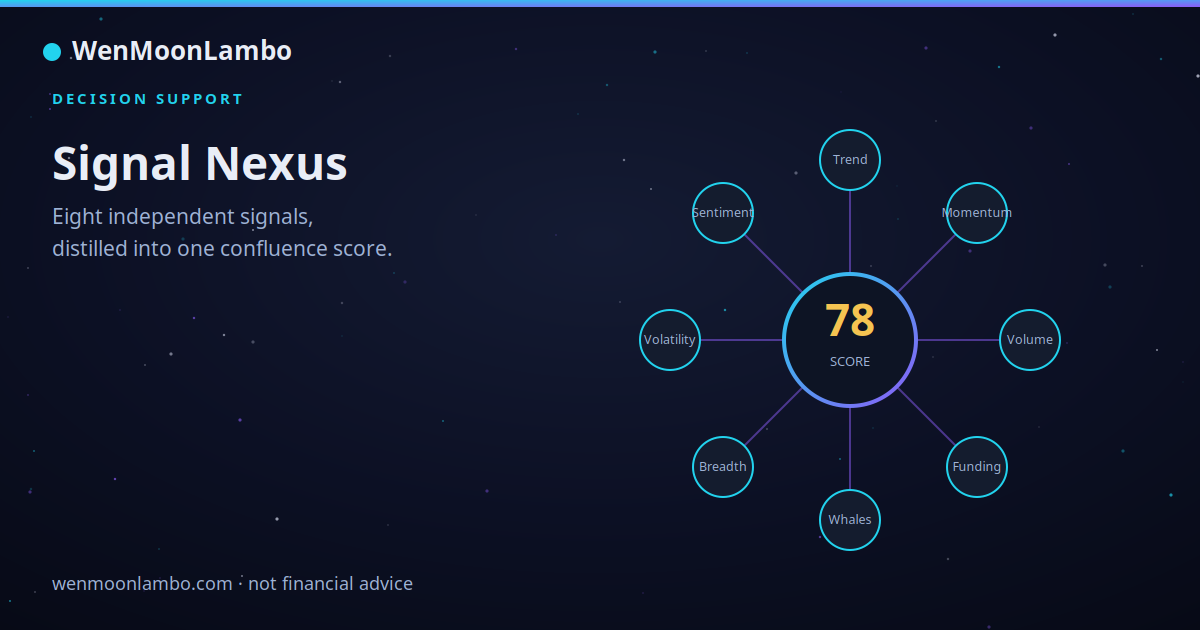
The average crypto trader's screen is a committee meeting that never adjourns: momentum says go, funding says careful, sentiment says euphoric, and an anonymous account with a frog avatar says "trust me." A crypto confluence score is an attempt to make that committee produce one honest number. Signal Nexus is how WenMoonLambo builds that number from eight sources — and this post is about what the number means, and just as importantly, what it doesn't.
The twelve-tab problem
Here's the uncomfortable truth about having more information: past a certain point, it makes decisions worse, not better.
Open twelve tabs and you'll always find something that agrees with the trade you already wanted to take. An oscillator here, a moving average there, a bullish thread somewhere else. This is cherry-picking, and every trader does it — not because they're dishonest, but because a pile of disagreeing indicators offers no principled way to weigh one against another. So the gut decides, and the tabs supply the justification afterwards.
The failure isn't the indicators. It's the absence of a fixed process for combining them. Same sources, same weights, same question, every single time — that's what a checklist is for, and it's what most traders never build.
What is a crypto confluence score?
Confluence is an old idea borrowed from rivers: separate streams merging into one flow. In analysis, it means independent lines of evidence pointing the same way. One method flagging a level is an observation; four unrelated methods flagging the same level is worth your attention.
A crypto confluence score simply formalises that. Take a fixed set of sources, score what each one currently says about a coin, weight them, and combine the result into a single 0–100 reading. High means the lenses broadly agree in one direction; low means they agree in the other; the murky middle means they disagree — which is itself useful information, because "no clear alignment" is an answer too.
The value of the score isn't precision. Nobody should believe that a 71 is meaningfully different from a 68. The value is discipline: the same sources get consulted in the same way every time, and cherry-picking after the fact becomes impossible. It's a checklist condenser, not an oracle.
The eight pillars of Signal Nexus
Signal Nexus aggregates eight sources into its score. In rough order of weight:
- Technical analysis. Trend, momentum and structure computed from real market data — the classic toolkit, calculated the same way for every coin.
- Wyckoff phase. A structural read of where the coin sits in the accumulation–markup–distribution–markdown cycle, so the score knows whether the chart looks like a base or a top being built.
- Sentiment. Crowd mood from live sources, the same data explored in depth on the sentiment workspace.
- Derivatives positioning. Funding rates and open interest — what leveraged traders are actually doing with their money, which is often more honest than what they're saying.
- Cycle timing. Where the broader market regime might sit — the kind of rotation context the Alt Season page is built around.
- Numerology. Yes, really — read on.
- Gematria. Same caveat.
- Astrology. Same caveat, with planets.
Those last three deserve a straight explanation. They're the entertainment lenses: pattern traditions our community genuinely enjoys exploring, included openly as exactly that, and given small weights so they can flavour the score but never drive it. We'd rather ship them clearly labelled than pretend the fascination doesn't exist — crypto has always had a mystic streak, and honesty about it beats false solemnity.
Hard data, heuristics, and honest labels
Not all eight pillars are the same kind of thing, and pretending otherwise would be the fastest way to make the score meaningless.
Some pillars are hard market data: funding rates, open interest, price and volume. These are facts about the market, independent of anyone's interpretation.
Some pillars are heuristics: sentiment scoring and phase classification involve judgment — rules somebody wrote down and encoded. Reasonable people could have written different rules. These pillars are informed opinions, systematically applied.
And some pillars are openly entertainment, as covered above.
Signal Nexus keeps these categories distinct rather than blending them into false precision, and you should hold them differently in your head too. A funding-rate extreme and a numerology alignment are not the same species of evidence, even when they end up in the same score.
Decision support, not a trade signal
This is the part that matters most, so here it is without decoration: Signal Nexus does not generate trades. It doesn't tell you to buy, sell, or do anything at all.
What it does is evaluate alignment — how many independent lenses currently lean the same way on a coin, and how strongly. That's decision support: input to a decision that remains entirely yours, made with your own plan, your own sizing, your own risk rules.
The distinction isn't legal fine print; it's how the tool actually works and the only intellectually honest way to use it. Alignment is not certainty. Eight lenses can lean the same way and still be wrong together, because market regimes shift and correlated methods fail in correlated ways. A confluence score compresses evidence. It cannot manufacture evidence that isn't there, and it can't peer around corners.
Anyone promising you a number that removes the need to think is selling something. This number is designed to make you think better, in less time, with less self-deception.
How to use a crypto confluence score sanely
A few patterns that respect what the score is:
Use it as triage. You can't deeply analyse fifty coins a day. A confluence score is a fast, consistent first pass that tells you which three charts deserve your actual attention. The score starts the homework; it never finishes it.
Use it as a devil's advocate. The score is most valuable when it disagrees with you. Convinced a coin is a screaming buy while the score sits in the basement? Don't discard the score — go find out which pillars object and why. Sometimes you'll refute them. Sometimes they'll save you from yourself.
Use it in your journal. Record the score when you open a paper position, then review whether alignment at entry told you anything across dozens of trades. That's how you calibrate trust in any tool: your own logged sample, not vibes.
Never trade the number. "Score crossed 70" is not a strategy. The score condenses your checklist; your plan — entry logic, invalidation, sizing — still has to exist and still has to be yours.
The good news: all of this can be practised without a cent at stake. The free paper-trading demo gives you $10k in play money on real Binance market data, which makes it the perfect sandbox for learning what confluence readings are — and aren't — worth.
The bottom line
A crypto confluence score won't predict the future, and Signal Nexus doesn't pretend to. What it kills is the twelve-tab ritual: the cherry-picking, the after-the-fact justification, the pile of indicators with no fixed way to weigh them. Eight sources, honestly labelled — hard data, heuristics, and openly-entertainment lenses — condensed into one consistent reading, so the tedious part of your checklist runs itself and the thinking part stays with you.
Use it as a filter, an argument partner and a journaling field. Never as an oracle. That's not a limitation we're apologising for — it's the design.
Nothing here is financial advice. WenMoonLambo is a paper-trading platform — all trading happens with play money on real market data.