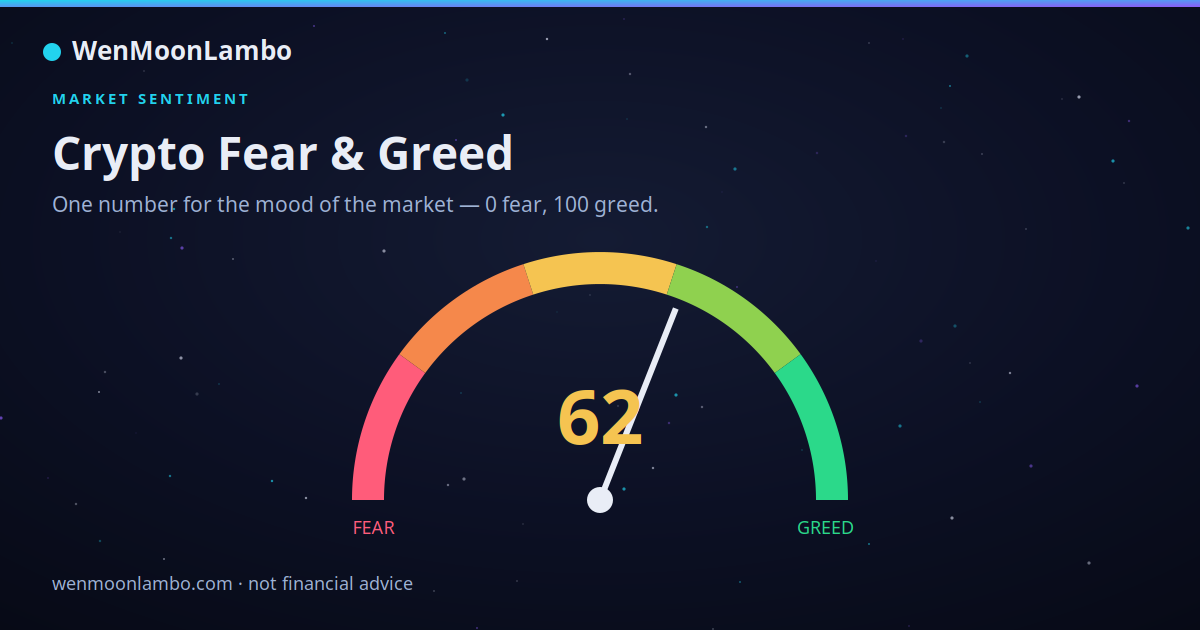
Quick answer: The crypto Fear & Greed Index is a 0–100 score of overall crypto-market mood. 0–25 is Extreme Fear, 26–46 Fear, 47–54 Neutral, 55–75 Greed and 76–100 Extreme Greed. It blends volatility, momentum, social activity and Bitcoin dominance. It describes the mood of the market. It doesn't predict the next move: across 3,169 days of data, buying Bitcoin on Extreme Fear days did worse than average over the following 90 days.
Somewhere on your screen right now, a little dial is announcing that the market is terrified or euphoric. The crypto Fear & Greed Index is one of the most-shared numbers in this industry, screenshotted at every top and every bottom, usually with a caption implying "you know what to do." Here's what it actually measures, what the numbers mean, what eight years of data say about trading it, and where it will quietly mislead you.
What the crypto Fear & Greed Index measures
A fear and greed index is a mood ring for the whole market, compressed onto a 0–100 scale. Low numbers mean fear, high numbers mean greed. The version most people screenshot is published daily by Alternative.me, and it states its own recipe:
| Input | Weight | What it reads as fear or greed |
|---|---|---|
| Volatility | 25% | Unusually large swings, especially down, read as fear |
| Momentum / volume | 25% | Strong buying on high volume reads as greed |
| Social media | 15% | Spikes in posts and engagement read as greed |
| Surveys | 15% | Weekly polls (currently paused) |
| Bitcoin dominance | 10% | Money fleeing into BTC reads as fear; spreading into alts as greed |
| Search trends | 10% | Rising searches like "bitcoin price manipulation" read as fear |
Notice what's not in there: nothing about any specific coin's fundamentals, roadmap or order books. The index is an aggregate of aggregates: a market-wide temperature reading, not a diagnosis of anything you're holding.
What the numbers mean
| Score | Label | Share of days, Feb 2018 – Oct 2026 |
|---|---|---|
| 0–25 | Extreme Fear | 23% |
| 26–46 | Fear | 29% |
| 47–54 | Neutral | 13% |
| 55–75 | Greed | 26% |
| 76–100 | Extreme Greed | 9% |
Two things jump out. First, the market spends more than half its time in some flavor of fear (52% of days), so a fearful reading on its own is ordinary, not a rare event. Second, extreme greed is the rarest state, at under one day in ten. The all-time extremes in the data are a low of 5 (August 2019) and a high of 95 (June 2019), two months apart.
Why contrarians stare at the extremes
Warren Buffett's most quoted line is the reason this dial exists: "be fearful when others are greedy, and greedy when others are fearful."
The contrarian logic runs like this. Sentiment extremes tend to come with crowded positioning. If seemingly everyone is euphoric, then in theory much of the buying that could happen already has. If everyone is terrified, sellers may be closer to exhausted. Extreme readings flag the moments when the crowd is leaning hard in one direction. Contrarians find those moments interesting precisely because the crowd's next collective move might be back the other way.
Notice the phrasing: "tend to," "in theory," "might." That's deliberate, and the data shows why.
Does buying extreme fear actually work? We checked 3,169 days
We lined up every daily Fear & Greed reading from February 2018 to October 2026 against Bitcoin's daily close, then asked a simple question: if you had bought BTC at the close on a day with a given reading, what happened next?
| Reading on the day you bought | Median BTC return 30 days later | Median return 90 days later | Up after 90 days |
|---|---|---|---|
| Extreme Fear | +1.6% | −4.1% | 45% |
| Fear | 0.0% | +2.5% | 52% |
| Neutral | +2.8% | +7.1% | 60% |
| Greed | +1.7% | +5.1% | 58% |
| Extreme Greed | +5.6% | +10.1% | 60% |
| Any day (baseline) | +1.6% | +3.1% | 54% |
That's the opposite of the screenshot wisdom. Over 30 and 90 days, Extreme Greed days were followed by the best median returns and Extreme Fear days by the worst. Momentum, not mean reversion, dominated the short and medium term.
Three more numbers explain why "buy the fear" hurts in practice:
- Extreme fear arrives early, not at the bottom. Of the 128 separate times the index entered Extreme Fear, Bitcoin then fell more than 10% further within 30 days in 47% of cases. The median extra drop was 9.4%, and the worst was 43%.
- It can last for months. The longest unbroken Extreme Fear run was 74 days, starting May 5, 2022, in the middle of that year's crash. The longest Extreme Greed run was 76 days, from November 2020.
- Patience is what paid, not the signal. On a one-year horizon, buying on Extreme Fear days returned a median +35%. That's good, but it's below the +42.5% for buying on any day at random over the same period.
The fine print: these are overlapping daily windows in a market that rose a lot overall, and a handful of regimes (the 2018 and 2022 bear markets, the 2020–21 bull run) carry much of the weight. It's a description of the past, not a rule. But it's enough to retire the idea that an extreme fear reading is a buy signal on its own.
The limits nobody prints on the dial
It's market-wide, not per-coin. The index says nothing about the specific coin you're looking at. The market can be greedy while your alt is in freefall, or fearful while something is quietly breaking out. Using a market-wide mood as a coin-specific trigger is a category error.
Extremes can stay extreme. "Extreme fear" is not a floor, as the 74-day streak above shows. If you buy the first extreme-fear print and the market keeps falling, nothing malfunctioned. That's a normal outcome. The index describes the mood; it doesn't time the turn.
It's descriptive, not predictive. Every input is something that already happened: realized volatility, existing momentum, posts already posted. At best you're getting a well-organized summary of the recent past. That's useful context, but it isn't a forecast.
How to actually use the crypto Fear & Greed Index
Treat it as context, never as commands.
- As a mirror. The dial's most underrated job is checking you. If it reads extreme greed and you're itching to buy, that's information about your own state of mind. You may be part of the crowd you think you're reading.
- As one input among several. Sentiment is one lens; trend, structure and levels are others. A mood reading on its own is a thin basis for any decision. The whole point of stacking lenses is that no single one carries the trade.
- As a journaling tool. Note the reading every time you open a paper trade. A few months later you'll have your own record of how you actually behave at extremes, and that's worth more than the index itself.
You can check today's Fear & Greed reading on WenMoonLambo, shown as overall market mood and deliberately kept separate from anything coin-specific.
Train the reaction, not the prediction
Here's the part almost nobody does. Everyone plans to be greedy when others are fearful. Very few people have actually clicked buy during extreme fear, because in the moment it feels terrible. That's what fear is.
The good news is that this reflex can be practiced. On WenMoonLambo you can try the $10,000 paper-trading demo free with no signup, on real Binance market data, and a new account gets 30 days of full Pro with no card. The next time the dial pins to an extreme, run your playbook for real: real prices, real volatility, zero real money. You'll find out fast whether you're a contrarian or just someone who enjoys the Buffett quote. If you want a framework to pair with the sentiment lens, the free TA course is the place to start.
Frequently asked questions
What is a good Fear & Greed Index number? There isn't a "good" number, only a description of mood. 47–54 is Neutral. Below 25 is Extreme Fear and above 75 is Extreme Greed. Since 2018, the market has spent 52% of days below 47.
Is the Fear & Greed Index a buy or sell signal? No. From February 2018 to October 2026, buying Bitcoin on Extreme Fear days produced a median 90-day return of −4.1%, against +3.1% for any day and +10.1% for Extreme Greed days. Treat the index as context.
How often is the crypto Fear & Greed Index updated? Alternative.me publishes a new value once a day, around midnight UTC.
What is the lowest the crypto Fear & Greed Index has been? In Alternative.me's history since February 2018, the lowest daily reading is 5, in August 2019. The highest is 95, in June 2019.
Does the Fear & Greed Index work for altcoins? Only as background. It's a market-wide reading weighted toward Bitcoin, so it says little about any individual altcoin's trend or fundamentals.
What goes into the crypto Fear & Greed Index? Alternative.me's index blends six weighted inputs: volatility (25%), momentum and volume (25%), social media (15%), surveys (15%, currently paused), Bitcoin dominance (10%) and search trends (10%). It says nothing about any single coin's fundamentals, roadmap or order books; it is a market-wide temperature reading.
Does extreme fear mean the crypto bottom is in? No. From February 2018 to October 2026, the index entered Extreme Fear 128 separate times, and in 47% of them Bitcoin fell more than 10% further within 30 days. The median extra drop was 9.4% and the worst was 43%, so extreme fear often arrived early, not at the bottom.
How long can extreme fear last in crypto? It can last for months. The longest unbroken Extreme Fear run in the Fear & Greed data since February 2018 was 74 days, starting May 5, 2022, during that year's crash. The longest Extreme Greed run was 76 days, from November 2020. Extreme fear is not a floor.
Does buying Bitcoin in extreme fear pay off over a year? It paid less than buying at random. From February 2018 to October 2026, buying Bitcoin on Extreme Fear days returned a median +35% over one year, below the +42.5% median for buying on any day over the same period. Patience did the work, not the fear signal.
How do traders use the Fear & Greed Index? As context, not as commands. It works as a mirror for your own state of mind, since extreme greed while you itch to buy may mean you are part of the crowd. It is one input alongside trend, structure and levels, and a journaling tool when noted on every trade.
The bottom line
The crypto Fear & Greed Index is a decent thermometer and a terrible oracle. It compresses the market's mood into one number, flags the moments when the crowd is leaning hard one way, and stops there. Eight years of data say extreme fear has more often been a stage on the way down than the bottom itself, and that being early hurt. Use it to understand the room, and to catch yourself becoming part of the crowd you're trying to read.
Data: daily Fear & Greed values from Alternative.me and Bitcoin daily closes (BTC/USDT) from Binance, February 1, 2018 – October 9, 2026. Returns are close-to-close and ignore fees. Nothing here is financial advice. WenMoonLambo is a paper-trading platform: all trading happens with play money on real market data.