Ask a Western astrologer for Bitcoin's Sun sign and you'll get a confident answer: Capricorn. Ask a Vedic astrologer the same question and you'll get an equally confident answer: Sagittarius. Same genesis block, same timestamp, same sky — two different signs. Neither of them is lying to you. They're just using different zodiacs, and the difference between those zodiacs is one of the most genuinely interesting stories in all of astrology.
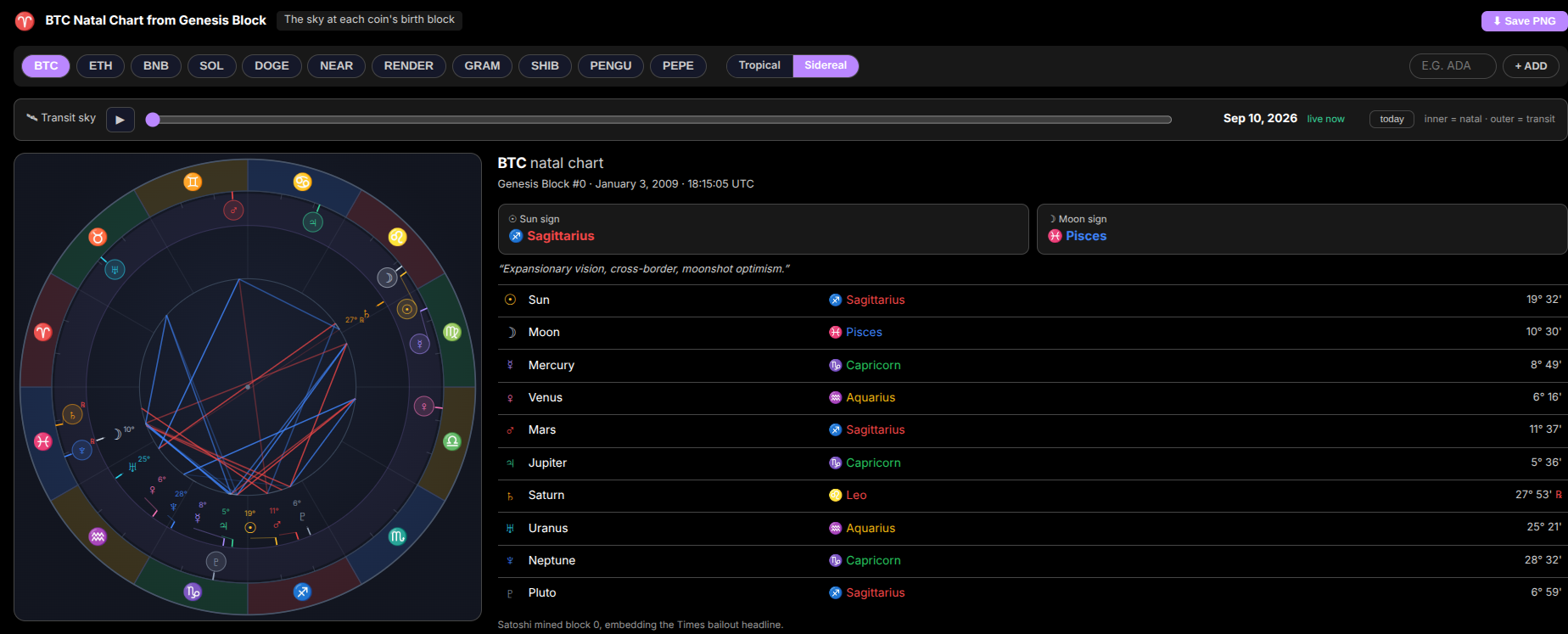
Bitcoin's genesis chart in sidereal mode, straight from the Genesis Natal tool — one toggle flips it between the two zodiacs.
If you haven't read our guide to Bitcoin's natal chart, start there — this post is the sequel, and it goes one layer deeper into the machinery.
Two rulers for the same sky
Both systems divide the sky into the same twelve 30° slices with the same names. The argument is about where the ruler starts.
The tropical zodiac — the one behind every newspaper horoscope in the West — anchors itself to the seasons. By definition, 0° Aries is wherever the Sun sits at the March equinox. It doesn't care which stars are behind the Sun at that moment; the zodiac is pegged to Earth's relationship with the Sun, full stop.
The sidereal zodiac — the backbone of Vedic (Jyotish) astrology — anchors itself to the stars themselves. 0° Aries is a fixed point against the actual constellations. If the Sun is standing in front of the stars of Sagittarius, sidereal astrology calls it a Sagittarius Sun, whatever the season says.
Once upon a time these two rulers agreed. Around 1,700 years ago the equinox point and the constellation boundaries lined up, and for one historical moment there was only one answer to "what sign is the Sun in?" Then the drift began.
The 24° problem: precession
Earth wobbles. Its axis traces a slow circle, like a spinning top winding down, completing one full loop roughly every 26,000 years. Astronomers call it the precession of the equinoxes, and it means the equinox point slides backward through the constellations by about one degree every 72 years.
Seventeen centuries of sliding adds up. Today the two zodiacs disagree by roughly 24 degrees — nearly a full sign. The offset even has a name, the ayanamsa, and Vedic astrologers maintain slightly different values of it the way traders maintain slightly different moving-average settings. The most widely used, Lahiri, puts the gap at close to 24° for Bitcoin's era.
So here's the punchline. At the genesis moment — 3 January 2009, 18:15 UTC — the Sun sat in mid-Capricorn tropically. Subtract the ayanamsa and the same Sun lands in sidereal Sagittarius. Both statements are internally consistent. Both are "correct." They just measure from different zero points.
Capricorn Bitcoin vs Sagittarius Bitcoin
Now the fun part: watch what each answer does to the story.
Capricorn Bitcoin is the tropical read, and it writes itself. Capricorn is the sign astrologers associate with structure, discipline, scarcity, and long unglamorous climbs — a fixed supply of 21 million coins, a protocol that grinds out blocks every ten minutes regardless of anyone's feelings, an asset famous for punishing impatience and rewarding the stubborn. The mountain goat, climbing forever.
Sagittarius Bitcoin is the sidereal read, and honestly? It also writes itself. Sagittarius is associated with optimism, excess, borderless wandering, philosophical crusades, and betting big on a belief. An asset born from a manifesto, adopted by true believers, famous for 80% drawdowns and 10x rallies, that recognizes no country and answers to no bank. The archer, firing arrows at the Moon.
Notice what just happened. Two contradictory signs, and both produced a satisfying, on-brand narrative for the same asset. That should set off a very specific alarm in your trader brain.
The lesson hiding in the ayanamsa
This is the part we actually care about, because it's the same phenomenon that costs traders real money — well, real paper money, if you're practicing properly.
When a story fits the evidence no matter which version of the story you pick, the story isn't analysis — it's decoration. Astrologers have argued about tropical vs sidereal for centuries without resolution, because both systems keep producing readings that feel right. Feeling right is cheap. A Capricorn Bitcoin and a Sagittarius Bitcoin can't both be the "true" cosmic identity, yet each one, read alone, is completely convincing.
Charts do this too. Show the same candles to a bull and a bear and each will find a clean pattern that confirms what they already believed. The indicator settings you choose, the timeframe you land on, where you decide the trend "really" started — those are your ayanamsa: a zero-point choice, made before the analysis, that quietly decides the conclusion. Learning to spot the moment you're choosing your zero point is one of the core habits we drill in the free TA course — and it's why the Signal Nexus exists, aggregating inputs that stay measurable no matter which story you're in the mood for.
Try both skies yourself
The interactive natal chart in the astrology workspace shows Bitcoin's genesis sky and today's transits drawn over it. As you follow the transits, keep tonight's question in your pocket: would this reading survive a 24° shift? It's a surprisingly clarifying question, and not just for astrology.
Is Bitcoin a Capricorn or a Sagittarius? Yes. Which is exactly why the planets stay in the entertainment column — and why, when it's time to actually test an idea, we'd rather you do it with a free practice account: $10k in paper funds, real market data, and no ayanamsa required.
The esoteric layer on WenMoonLambo is entertainment — a lens for curiosity, not trading advice.
Nothing here is financial advice. WenMoonLambo is a paper-trading platform — all trading happens with play money on real market data.